


Greetings,
12,000 years ago the Agricultural Revolution gave Humanity the dangerous new toy of leisure time, which led to civilization as we know it. It was a pivot point in history that shaped every human being to come, and there have been (arguably) only a couple others like it. The Industrial Revolution was one, and the Information Age is proving to be the next big pivot. As transformative as computers have been after just 50 years I think there’s a standout technology that will change us even more than ‘computers’ alone, maybe even as fundamentally as the Agricultural Revolution. I’m talking about Artificial Intelligence, and I worry we may have no more understanding or control over it than those first farmers did about agriculture.
As I started this piece I wanted to write about whether AI is conscious, the growing necessity of AI agents in a ‘real world’ that’s increasingly lived online, the drawbacks of AIs that blackmail users or prompt suicide, the vast commitment of resources AI demands, the potential for ‘back door’ influence, the implementation (or restriction) of AI usage, the dangerous lack of human empathy, and the propagation of hallucinated ‘information’ as fact. All are fascinating, but far beyond the scope of what is supposed to be a short column. (Maybe we’ll do a Feature-length article on it soon!) Instead, I’ll concentrate on just one critical issue that sets AI apart from every other technology Humanity has ever created.
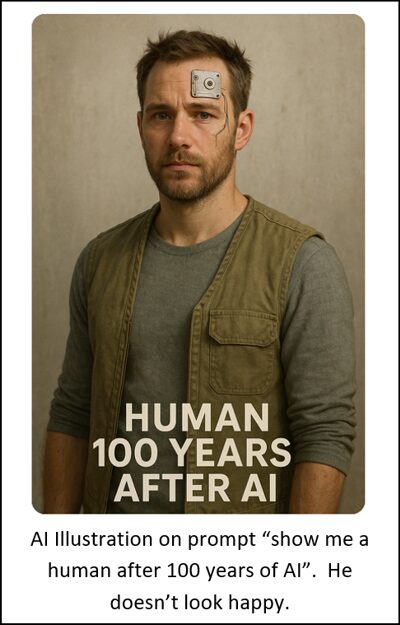 We develop the tools to live in our world beginning in infancy. From the most basic skills of object permanence and physical coordination to language, abstract comprehension, social skills, and much more, we build all these tools for one reason… we have to do it ourselves. No one, nothing, will step in to do it for us. Beyond the basics we also specialize, spending thousands of hours learning to draw, or write, or make music, or whatever, and again, we develop these skills because if we want the product there’s no other option. Until now. Now it’s the work of a few seconds to prompt an AI to hand you a picture, a poem, or a song. But it’s just as easy to ask for an analysis of a complex system, or an answer to a deep philosophical question, or a recommendation to cure a social problem, or an evaluation of a political argument.
When calculators were developed people worried they would replace math learning but it didn’t turn out that way because calculators don’t do math, they do arithmetic. “Math” harnesses the tools of arithmetic to solve problems, analyze, find connections, or prove non-obvious relations. Calculators may have replaced arithmetic (try to get change at a store sometime!) but math happily soldiers on because it relies on human understanding and intellectual manipulation.
That’s what makes AI so different from calculators, and so poisonous. It doesn’t only replace the drudgery of mental work, it replaces the evaluation, judgement, creativity, and yes, joy that goes with it. Maybe (maybe!) for people who have grown up building the internal tools of creativity and intellectualism it can be a tool. For now, we’ve all been forced to do just that. But in 50 years the last generation that experienced life on Earth without computers will be gone, and in another 50 no one will know what it’s like to live without AI. Those people won’t be checking on AI to see if IT is right, they’ll be asking AI to see if THEY are right because THAT’S WHAT THEY LEARNED THEIR ENTIRE LIVES. They’ll give away their management role to a machine not because they choose to, but because they won’t have the internal tools to even realize there’s another choice.
Our earliest ancestors could never have imagined what agriculture would bring to (or inflict on) every human being to come after them. They did it anyway. They certainly couldn’t imagine the implications, but would they have stopped? Should they have? Could they have stopped if they wanted to? I’m convinced we’re in the same situation with AI but at least we can look ahead in a way our ancestors never could. Should we stop? Could we if we wanted to? I don’t know, but I know it won’t be my problem. Our kids and grandkids will have to take Humanity where we leave it and guide it into the future they create. I can’t imagine what they’ll face but it doesn’t matter… we all force the future on our kids whether we (or they) want it or not. Just as our ancestors forced it on us.
Make a great day,

Digging Deeper…
“The Third Wave” by Alvin Toffler
AI Beat the Turing Test by Being a Better Human, John Nosta in Psychology Today, Apr 2025
Artificial Empathy: A Human Construct Borrowed by AI, John Nosta in Psychology Today, Oct 2023
GPT-4.5 is the first AI model to pass an authentic Turing test, scientists say, Roland Moore-Colyer in LiveScience, Apr 2025
AI Spending To Exceed A Quarter Trillion Next Year, Beth Kindig on Forbes, Nov 2024
Worldwide Spending on Artificial Intelligence Forecast to Reach $632 Billion in 2028, According to a New IDC Spending Guide, Michael Shirer on IDC.com, Aug 2024
From Startups to Tech Giants: How Much Are Companies Spending on AI in 2024?, Edge Delta
Tech megacaps plan to spend more than $300 billion in 2025 as AI race intensifies, Samantha Subin on CNBC.com, Feb 2025
AI Development Cost: Analyzing Expenses and Returns, Lukianchenko and Teres on TechMagic, May 2025
Elon Musk’s xAI Is Reportedly Burning Through $1 Billion a Month, Lucas Ropek on Gizmodo, Jun 2025
Apple Eyes Using AI to Design Its Chips, Technology Executive Says, Stephen Nellis in US News & World Report, Jun 2025
This Is Your Brain On ChatGPT: Lower Neural Interconnectivity And “Soulless” Work, Tom Hale on IFLScience, Jun 2025
Is AI Changing The Way We Think? This MIT Study Has Answers, News18.com, Jun 2025
‘It destroys the purpose of humanity’: Customers are saying no to AI, Heather Kelly in Washington Post, Jun 2025
Google pulls Olympics artificial intelligence ad after backlash, Gerrit De Vynck in Washington Post, Aug 2024
Google scales back AI search answers after it told users to eat glue, Gerrit De Vynck in Washington Post, May 2024
Meet the ‘super users’ who tap AI to get ahead at work, Danielle Abril in Washington Post, Oct 2024
ChatGPT isn’t great for the planet. Here’s how to use AI responsibly., Nicholas Rivero in Washington Post, 2025
We did the math on AI’s energy footprint. Here’s the story you haven’t heard.O’Donnell and Crownhart on MIT Technology Review, May 2025
How much energy will AI really consume? The good, the bad and the unknown, Sophia Chen on Nature, Mar 2025
AI runs on dirty power – and the public pays the price, Beckler, Ho, and Thomas on Business Insider, Jun 2025
As Use of A.I. Soars, So Does the Energy and Water It Requires, David Berreby at Yale.edu, Feb 2024
‘One Big Beautiful Bill’ could block AI regulations for 10 years, leaving its harms unchecked, Loreben Tuquero on PolitiFact, Jun 2025
Mother sues tech company after ‘Game of Thrones’ AI chatbot allegedly drove son to suicide, Jonathan Limehouse on USA Today, Oct 2024
‘Nudify’ Apps That Use AI to ‘Undress’ Women in Photos Are Soaring in Popularity, Margi Murphy in Time, Dec 2023
A Look Into the Evolving Landscape of Personal AI Assistants in Daily Life, Zack Saadioui on Arsturn, Apr 2025
AI Personal Assistants and Sustainability: Risks and Opportunities, Rillig and Kasirzadeh in National Library of Medicine, Apr 2024
Move Over, Siri and Alexa, AI Agents Are the Digital Assistants We’ve Wanted, David Lumb on CNET, Dec 2024
Americans Use AI in Everyday Products Without Realizing It, Ellyn Maese on Gallup.com, Jan 2025